Writing · Men's health
Why Do 9 Out of 10 Men Who Start TRT Eventually Quit?
This is educational information, not medical advice. To be clear, some men genuinely need TRT. Real structural failure exists, it's serious, and for those men replacement can be the right call. This isn't about demonising the treatment or the people who prescribe it. It's about one specific thing most men are never walked through before they start: dependence.
According to published research, only roughly 1 out of 10 men are still on TRT after 10 years.[1]
Despite what some market as "lifetime optimisation", research suggests 9 out of 10 men eventually walk away from testosterone replacement therapy.
And most don't even last a year: a pooled review of 20 separate US studies found 80–85% of men discontinue TRT within the first year.[9]
Harvard Medical School calls this "the testosterone trap" [2]—a term I'll use not as hyperbole, but because it's the exact language used by one of the world's most prestigious medical institutions to describe this phenomenon.

What you're hearing about TRT sounds promising… Regular injections. Quick results. Join the ranks of "optimised" men. Get back to peak performance.
But there are some pretty important questions that don't seem to get much attention:
- What caused your testosterone to decline in the first place—and why isn't addressing THAT root cause discussed more often?
- Medical literature explicitly describes 'testosterone dependence' [3] - shouldn't the actual cause get diagnosed before committing to a lifelong treatment?
- And here's the question that should make you pause: If this approach is so effective, why do 9 out of 10 men eventually abandon it?
As someone who's built their success on knowing which decisions deserve deeper scrutiny, you deserve to see the full picture before making any long-term medical commitments.
What you're about to discover is information about TRT that, in my opinion, rarely makes it into the glossy marketing materials—once you know this, you'll never look at "lifetime optimisation" the same way again.
TRT’s Short & Long-Term Continuation Rates
Before we continue, I need to address something important. This article isn't about demonising TRT or the medical professionals who prescribe it.
Let's be clear: Some men absolutely need TRT. For example, actual testicular failure—is real and requires medical intervention.
This series is all about showing you the data that should make you question whether YOU need it.
Let’s skip straight to the meat of the matter. Here's what the research reveals about long-term TRT continuation rates...
Not just one study. Not just a few men. Multiple clinical trials tracking tens of thousands of men all follow a similar pattern.
STUDY #1: The First Prescription Data (37,741 Men Tracked) [4]
Canadian researchers tracking 37,741 men over 17 years in a universal healthcare system documented early TRT discontinuation patterns:
Prescription Drop-Off Rates:
- 26% discontinued after just 1 prescription
- 39.5% discontinued after just 2 prescriptions
- 48% never filled more than 3 prescriptions total
- Only 27% received more than 10 prescriptions total over the entire 17-year period
More than 1 in 4 men don't make it past their first prescription.
This pattern continues at various time intervals, shown through multiple studies.
STUDY #2: The 3-Month Data (15,952 Men Tracked) [5]
Another clinical study tracking 15,952 men shows a similar pattern.
3-Month Continuation Rates:
- Topical TRT: Only 54% Continued (46% quit within 3 months)
- Injection TRT: Only 37% Continued (63% quit within 3 months)
The study documented two distinct usage patterns:
Group 1: Permanent* Discontinuers (~40% of Participants)
The following chart shows the drop off rate as a percentage of the total group over months by the two different forms of TRT used in the study.
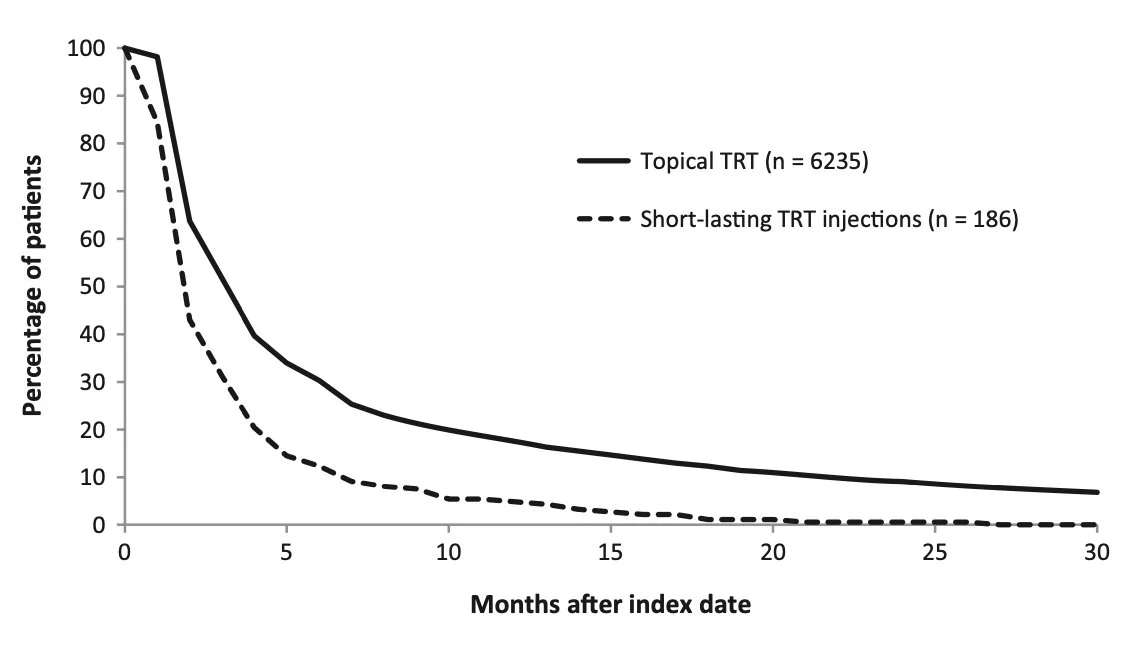
- Out of 15,435 topical TRT users 6,235 discontinued permanently*
- Out of 517 injection users 186 discontinued permanently*
- A second analysis followed the same 15,435 topical users to 12 months. Only 15.4% were still on treatment at one year [8].
- Not just this dataset, either. A 2017 review pooled 20 separate US studies and found the same pattern: after 1 year, 80–85% of men discontinue TRT [9].
*“permanent discontinuation” meaning, for the remainder of the study (they may have continued after the study)
Group 2: Cyclic Users (~60% of Participants)
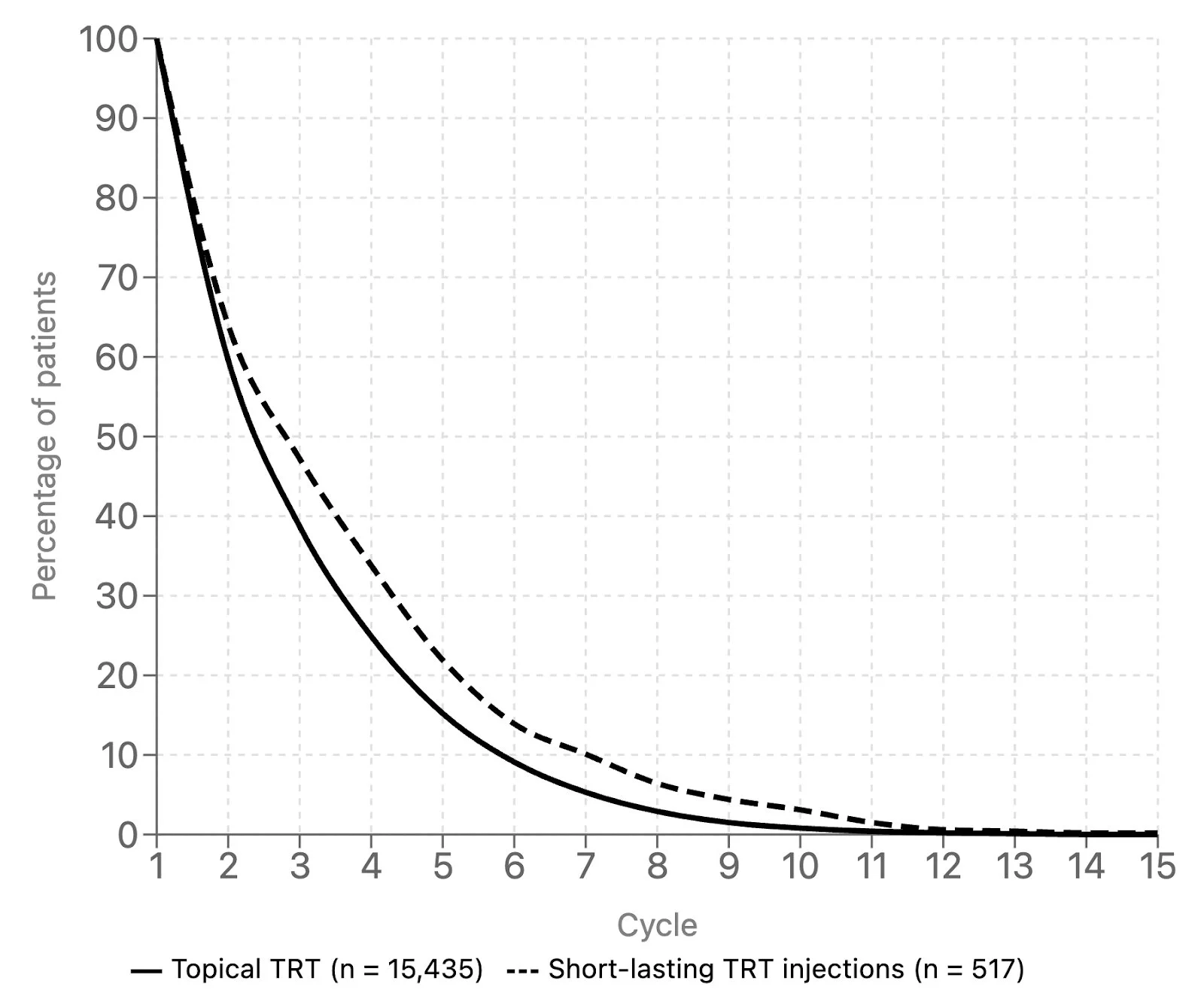
This table shows the stop-start pattern of users over 15 cycles (periods of TRT use followed by breaks). You can see “number of patients” showing patient drop off at each cycle, with “length of therapy” being time on TRT and the “gap” being the time off TRT.
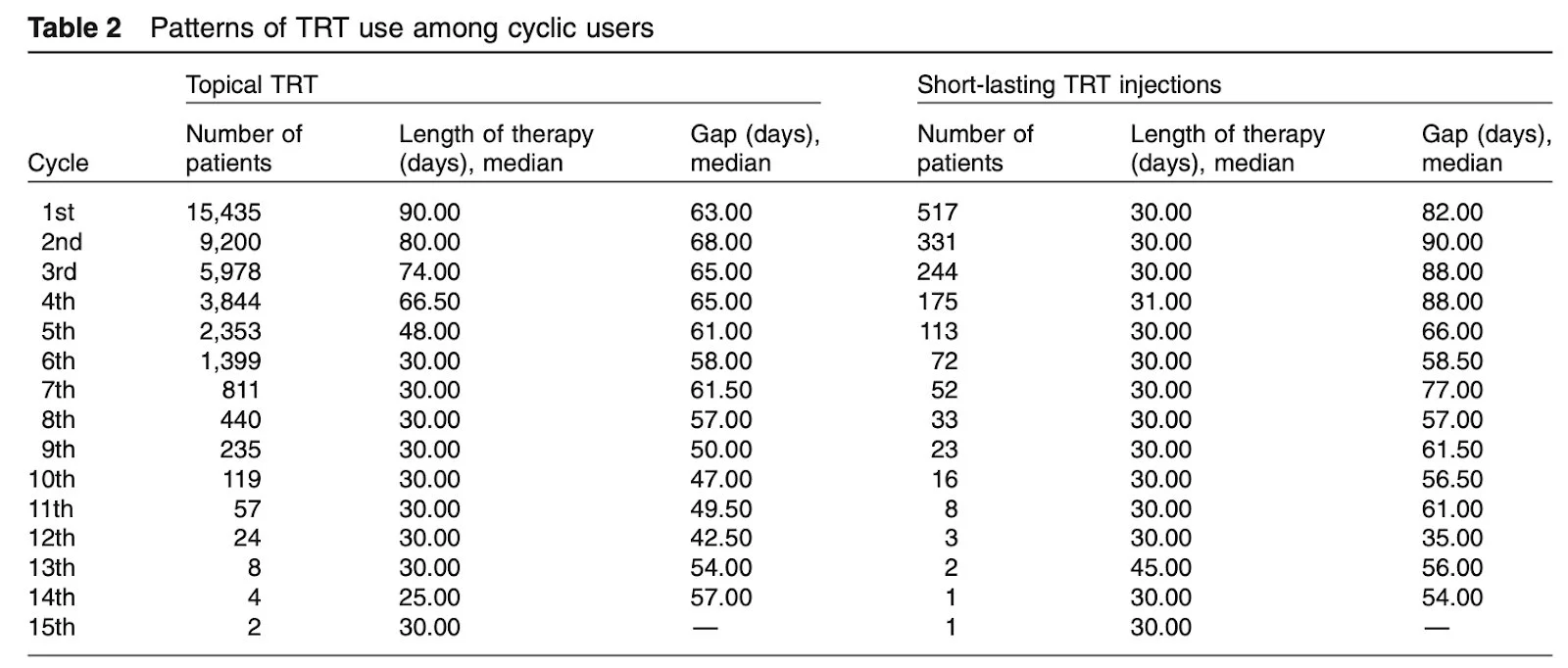
The Cyclic Use Data Shows:
- 15,435 men started on topical TRT → 2 men reached a 15th cycle
- 517 men started on injection TRT → 1 man reached a 15th cycle
- 9,200 topical TRT users who showed stop-restart patterns
- 331 injection users who showed stop-restart patterns
- Treatment duration appeared to decrease with each cycle (from ~90 days to ~30 days)
- Gaps between cycles appeared to shorten over time (from ~90 days to ~50 days)
- Approximately 40-50% men discontinued with each subsequent cycle.
STUDY #3: The ~2-Year Data (5,246 Men Tracked) [6]
One of the largest and most recent TRT safety studies, the TRAVERSE study, has a similar pattern. Let's examine what happened to participant retention over a 2 year study period.
2-Year Continuation Rates:
- Started: 5,246 men (roughly half testosterone, half placebo)
- Discontinued: ~61% (61.4% testosterone / 61.7% placebo)
- Patients received their assigned regimen for only ~67% of the potential treatment time (meaning roughly a third of their time was spent off treatment.)
One honest caveat: the placebo group discontinued at essentially the same rate as the testosterone group, so this figure reflects how hard men find it to stick with their regime. Discontinuation reasons weren't tracked here.
Treatment Adherence Reality:
- 21% withdrew before end-of-trial visits began
- Additional 18% did not attend their final visit
STUDY #4: The 10-Year Data (640 Men Tracked) [1]
Here's what the research shows for longer-term continuation:
- Testosterone gel: 2.6% continuation (97.4% quit)
- Oral Testosterone: 10.4% continuation (89.6% quit)
- Testosterone enanthate (injectable): 13.0% continuation (87.0% quit)
- Even "premium" undecanoate (injectable): 16.7% continuation (83.3% quit)
- TOTAL across all types: 11.3% continuation (88.7% quit)
This is clinical research tracking 640 men across 10 years published in medical journals.
The data shows that, no matter what form of TRT they are on, roughly 9 out of 10 men eventually quit.
Pre-Treatment Testosterone and Continuation Rates
This 10-year study also tracked continuation rates by pre-treatment testosterone levels:
Men starting with Testosterone less than 200 ng/dL (6.9 nmol/L) (275 patients):
- After 1 year: 84.7% still on treatment (15.3% had discontinued)
- After 5 years: 36.4% still on treatment (63.6% had discontinued)
- After 10 years: 18.2% still on treatment (81.8% had discontinued)
Men starting with Testosterone between 200-300 ng/dL (6.9-10.4 nmol/L) (365 patients):
- After 1 year: 69.3% still on treatment (30.7% had discontinued)
- After 5 years: 30.4% still on treatment (69.6% had discontinued)
- After 10 years: Only 6.0% still on treatment (94.0% had discontinued)
The data suggests that men starting at 200-300 ng/dL are less likely to continue than men starting at <200 ng/dL.
Now imagine if you're starting from above 300 ng/dL (10.4 nmol/L)?
One more detail buried in this study: even among the men tracked across the full 10 years, total time actually on treatment averaged just 30.9 months per patient — about 26% of the decade.
So a "10-year user" was, on average, OFF testosterone for roughly 74% of those ten years.
Why They Really Quit (154 men) [1]:
✗ Inconvenience: 29.9%
✗ Cost: 23.4%
✗ Side Effect Concerns: 23.4%
✗ Lack of Efficacy: 16.2% (~1 in 6 didn't feel it was working for them)
✗ Symptom Recovery: 7.1% (Some achieve their goals and stop)
And it lands hardest on one specific form: among men on the fast-acting enanthate injection, side effects were the #1 reason for quitting — 52.4% of men chose this. The study ties it to that form's rapid post-injection spike-and-crash.
The Discontinuation Timeline
Let's review the complete pattern:
🛑 1 Prescription: ~26% have discontinued
🛑 3 Months: ~48%-69% have discontinued [Topical%-Injection%]
🛑 1 Year: ~80-85% have discontinued (pooled across 20 US studies)
🛑 2 Years: ~61% have discontinued (TRAVERSE — placebo matched)
🛑 10 Years: ~83-97% have discontinued [Undecanoate%-Gel%]
🛑 “Long-term users”: Documented as not on TRT ~74% of the time
These are some pretty significant numbers, right?
But, everyone seems to be thriving on TRT…
Consider survivorship bias: The men still talking positively about TRT are likely the ones who haven't discontinued yet. The ones who walked away aren't bringing it up at the golf club. You're hearing from current users, not those who've moved on.
I decided to ask those who were commenting, offering words of encouragement, “How long have you been on TRT?”. The following was a selection of the responses.
"Survivorship Bias" in action:





Note: These are unverified social media posts.
Notice the pattern:
- 14 months
- A little over a year
- 3 months
- 4 months
- 8 weeks
These are the voices you hear in TRT communities - men who are still ON treatment, ranging from weeks to months, with a small handful in the years. They're actively advocating, giving advice, telling others to "trust the process”.
What you DON'T see are posts from the ~89% who quit. Those men have already moved on.
To understand this trend better, I surveyed active TRT community members across 4 separate groups on Facebook about their experience timeline:
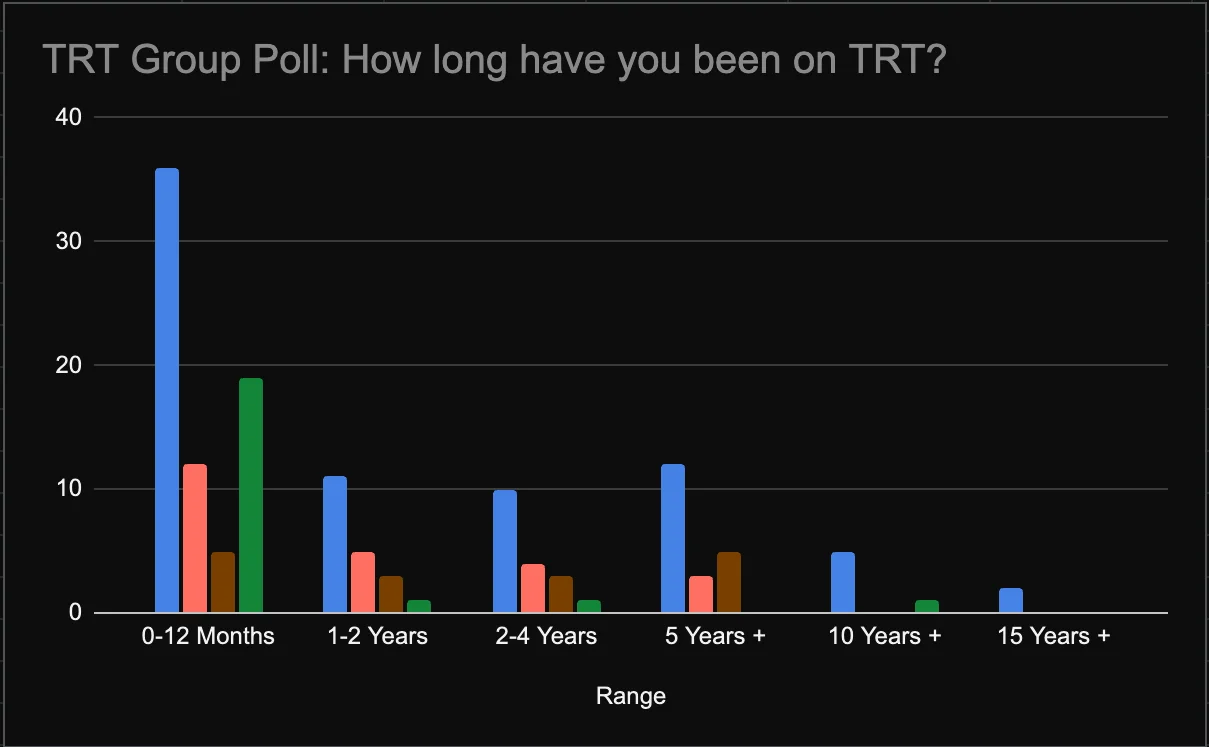
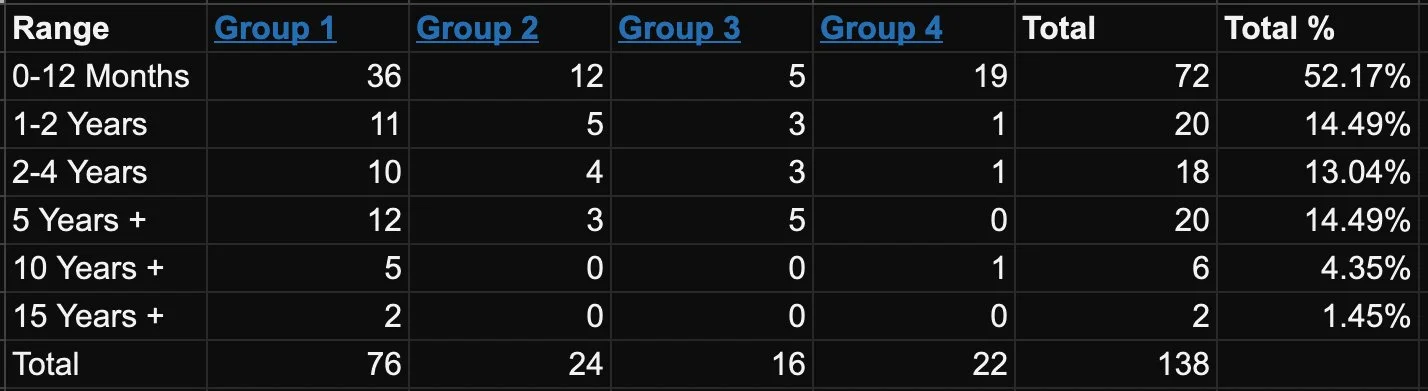
Source: Facebook TRT community survey, 138 voluntary responses, July 2025
The results suggest:
- ~52% have been on TRT for less than 12 months
- Only ~20% have sustained it for 5+ years
- A mere ~6% have made it past the 10-year mark
Although this was a small sample size, this data aligns with study continuation statistics, suggesting the majority of active community members are relatively new to TRT.
TRT Clinic Data Mirrors This Trend
A 2024 survey of 905 TRT users from across multiple private UK clinics showed a remarkably similar pattern when they were asked “How long have you used TRT for?” [7]:
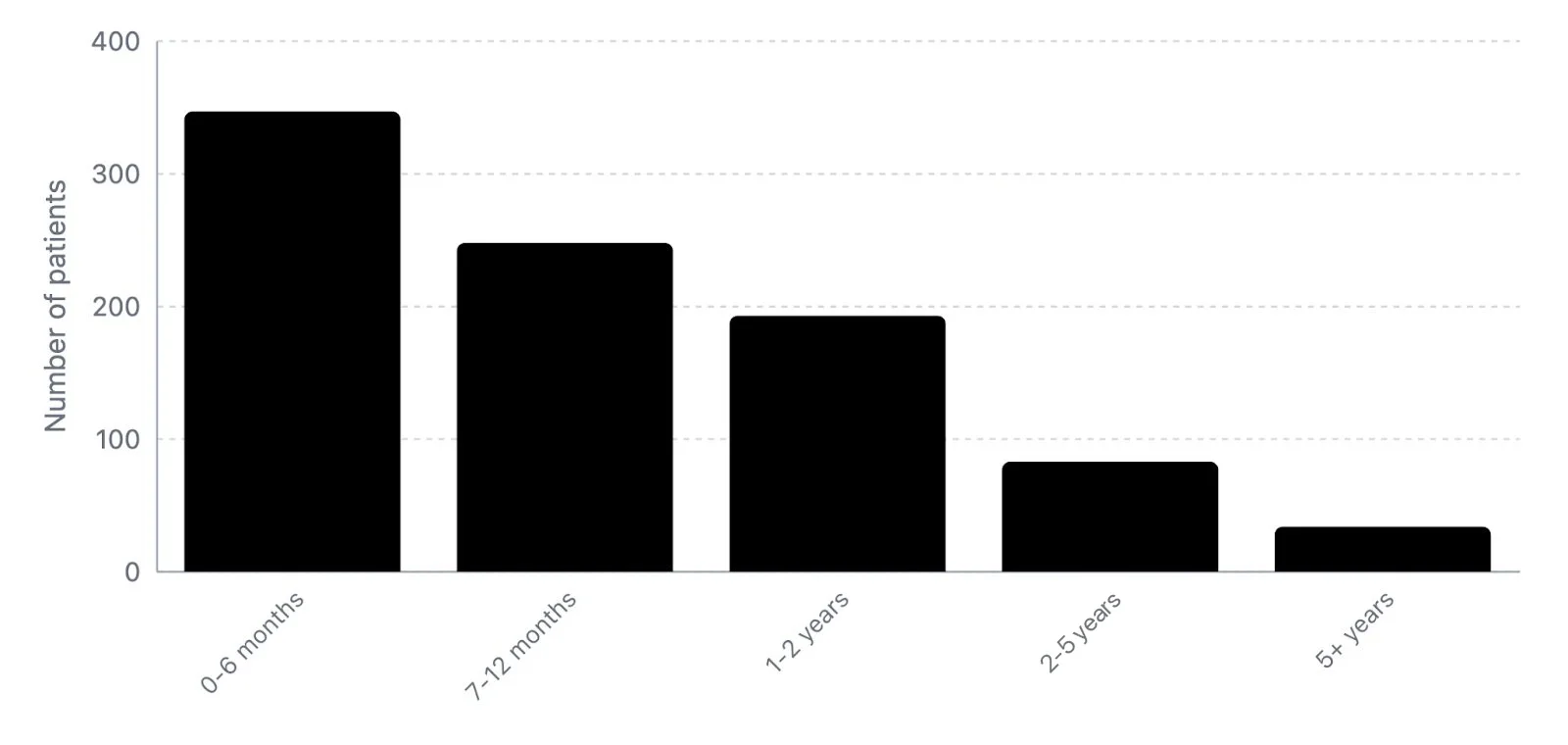

Important note: This survey asked current patients at one moment in time - it didn't follow the same group of people over years.
Patient Distribution:
0-6 Months: 38.3% of respondents
7-12 Months: 27.4% of respondents
1-2 Years: 21.3% of respondents
2-5 Years: 9.2% of respondents
5+ Years: 3.8% of respondents
This distribution pattern shows that 65% of survey respondents had been on TRT for less than 12 months, while only 3.8% reported using TRT for more than 5 years.
This study was run by the clinics themselves.
This same study also claims: "The majority (85%) reported testosterone replacement therapy as effective or very effective."
But… Where are all the long-term users?
Educational information, not medical advice. Bring it to your own doctor.
References
[1] Kang B, Noh M, Park HJ. Compliance with Testosterone Replacement Therapy in Patients with Testosterone Deficiency Syndrome: A 10-Year Observational Study in Korea. World J Mens Health. 2022;40(4):686. doi:10.5534/wjmh.200174
[2] Is testosterone therapy safe? Take a breath before you take the plunge. Harvard Health. January 10, 2014. https://www.health.harvard.edu/mens-health/is-testosterone-therapy-safe-take-a-breath-before-you-take-the-plunge
[3] Muir CA, Wittert GA, Handelsman DJ. Approach to the Patient: Low Testosterone Concentrations in Men With Obesity. J Clin Endocrinol Metab. 2025;110(9):e3125-e3130. doi:10.1210/clinem/dgaf137
[4] Locke JA, Flannigan R, Günther OP, Skeldon S, Goldenberg SL. Testosterone therapy: Prescribing and monitoring patterns of practice in British Columbia. Can Urol Assoc J. 2020;15(2). doi:10.5489/cuaj.6586
[5] Donatucci C, Cui Z, Fang Y, Muram D. Long-Term Treatment Patterns of Testosterone Replacement Medications. J Sex Med. 2014;11(8):2092-2099. doi:10.1111/jsm.12608
[6] Lincoff AM, Bhasin S, Flevaris P, et al. Cardiovascular Safety of Testosterone-Replacement Therapy. N Engl J Med. 2023;389(2):107-117. doi:10.1056/NEJMoa2215025
[7] El-Osta A, Liu VN, Huang D, et al. A cross-sectional survey of experiences and outcomes of using testosterone replacement therapy in UK men. Transl Androl Urol. 2025;14(5):1295-1307. doi:10.21037/tau-2024-738
[8] Schoenfeld MJ, Shortridge E, Cui Z, Muram D. Medication adherence and treatment patterns for hypogonadal patients treated with topical testosterone therapy: a retrospective medical claims analysis. J Sex Med. 2013;10(5):1401-1409. doi:10.1111/jsm.12114
[9] Bandari J, Ayyash OM, Emery SL, Wessel CB, Davies BJ. Marketing and Testosterone Treatment in the USA: A Systematic Review. Eur Urol Focus. 2017;3(4-5):395-402. doi:10.1016/j.euf.2017.10.016