Writing · Men's health
TRT Dependence — What the Medical Literature Actually Says
This is educational information, not medical advice. To be clear, some men genuinely need TRT. Real structural failure exists, it's serious, and for those men replacement can be the right call. This isn't about demonising the treatment or the people who prescribe it. It's about one specific thing most men are never walked through before they start: dependence.
TRT Dependence In Medical Literature
Here's a documented issue that rarely gets discussed in a TRT consultation.

Read that last part again: testosterone dependence. [1]
Not "discontinuation syndrome." Not "adjustment challenges." The medical community uses the word DEPENDENCE — the same terminology reserved for substances that create physiological and psychological reliance.
This isn't my interpretation. This is published medical literature acknowledging that testosterone treatment can lead to dependence — listed right alongside complications like infertility and blood clotting disorders. I'm using the medical community's own terminology.
And this isn't just one paper's choice of word. That same warning is on the label. Every approved testosterone medication, in the US, the UK, Canada, Australia and New Zealand, is required to carry a dependence and withdrawal warning in its official product information — and those are just the countries I checked. Five separate regulators, independently, land on the same word. So it's worth reading exactly what they mean by it.
The Official Definition
Here's the definition pulled straight from the manufacturer's own fact sheet for a common testosterone medication: [2]
"Physical dependence is characterised by withdrawal symptoms after abrupt drug discontinuation or a significant dose reduction of a drug. Individuals taking supratherapeutic doses of testosterone may experience withdrawal symptoms lasting for weeks or months which include depressed mood, major depression, fatigue, craving, restlessness, irritability, anorexia [loss of appetite], insomnia, decreased libido and hypogonadotropic hypogonadism [the body's own testosterone signalling shutting down]."
That's the drug's own paperwork describing what coming off can feel like — and it's a fair part of why most men who try to stop end up restarting. It's the mechanical spine of the "testosterone trap" Harvard described: [3]

Note what that shutdown does, because it matters.
Suppressing your own production is what synthetic testosterone does at any dose, standard replacement included: the labels state that exogenous (man made) testosterone shuts down the brain's signal to the testes, so your own supply winds down. [13] That part isn't about abuse or high doses. It's how the drug works on anyone.
Once your production is switched off, stopping the injections doesn't switch it back on. The system has to restart, and in that gap you're running on less than you began with.
What the label pins specifically to supratherapeutic doses is the severe end of this — the weeks-to-months withdrawal list quoted above.
So the dose decides how hard the landing is. It doesn't decide whether there's a landing at all — that's built into taking TRT in the first place.
What does "supratherapeutic" actually mean?
In plain English: higher-than-recommended doses.
So what counts as recommended?
- The American Urological Association defines therapeutic success as testosterone levels in the normal physiologic range of 450–600 ng/dL (15.6–20.8 nmol/L) — the reference range for most labs. [4]
- The British Society for Sexual Medicine puts the therapeutic range at 433–865 ng/dL (15–30 nmol/L). [5]
Anything above that is what medical authorities classify as "supratherapeutic" — above the therapeutic range.
Hold that word; it matters in a minute.
The Reality of Injection Timing
When you measure testosterone matters as much as what you measure.
Standard practice measures at "trough" — the lowest point, right before the next injection. But testosterone peaks 24–48 hours after a shot, then falls. So the trough is the floor, not the average.
If a man injecting weekly has a trough of 800 ng/dL (27.7 nmol/L), his peak days earlier may have been well over 1,200 ng/dL.
Do the math:
- AUA therapeutic range: 450–600 ng/dL
- BSSM therapeutic range: 433–865 ng/dL
- His trough: 800 ng/dL
- His likely peak: 1,200+ ng/dL
- Time spent above the therapeutic range: potentially most of the week
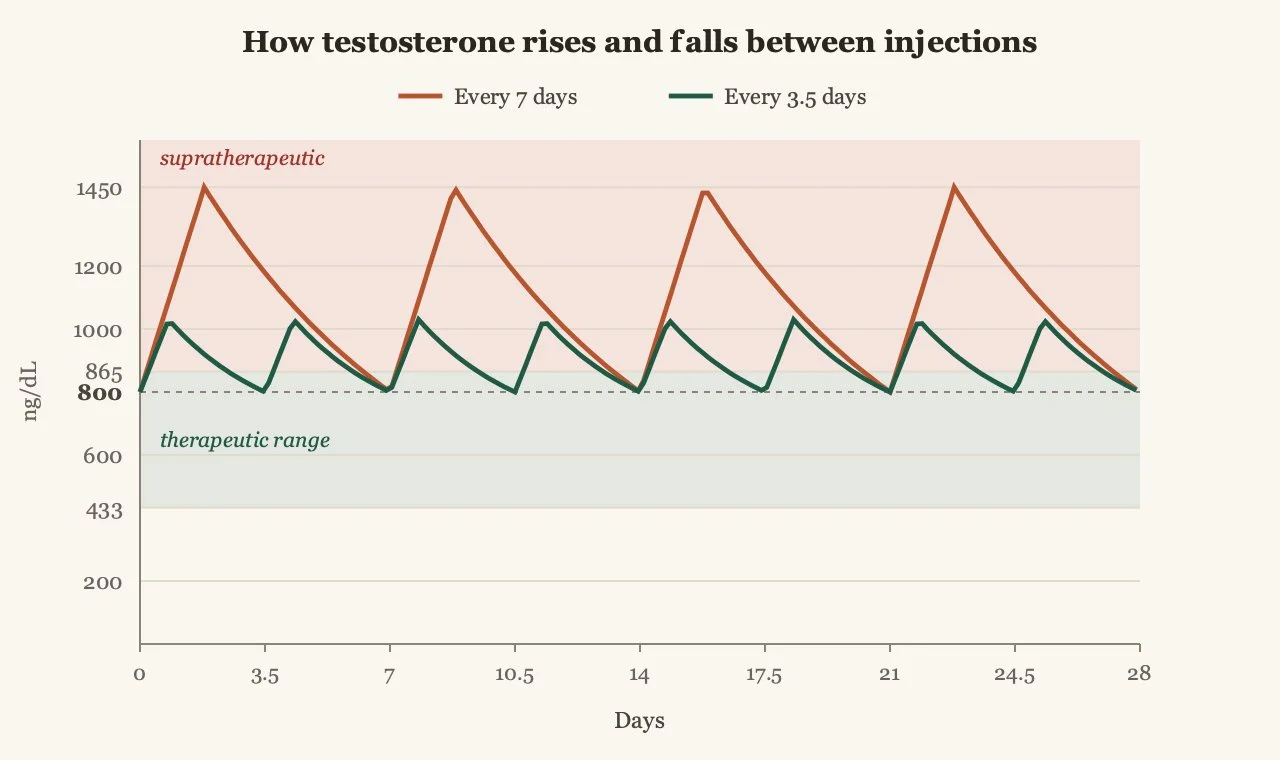
A note before the next part: any discussion of very high testosterone levels here is for educational purposes only. I don't advise pursuing them — they carry real risk. The point isn't to chase those numbers. It's that many men are sitting at them without realising.
The Gap Between Official Guidelines and Common Practice
Spend time in TRT communities and you'll see men report feeling best well above the guideline ranges — a large share at levels roughly double them. The samples are small and self-selected — take them with a big pinch of salt — but the direction is consistent across forums: real-world dosing tends to run above what the guidelines call "success."
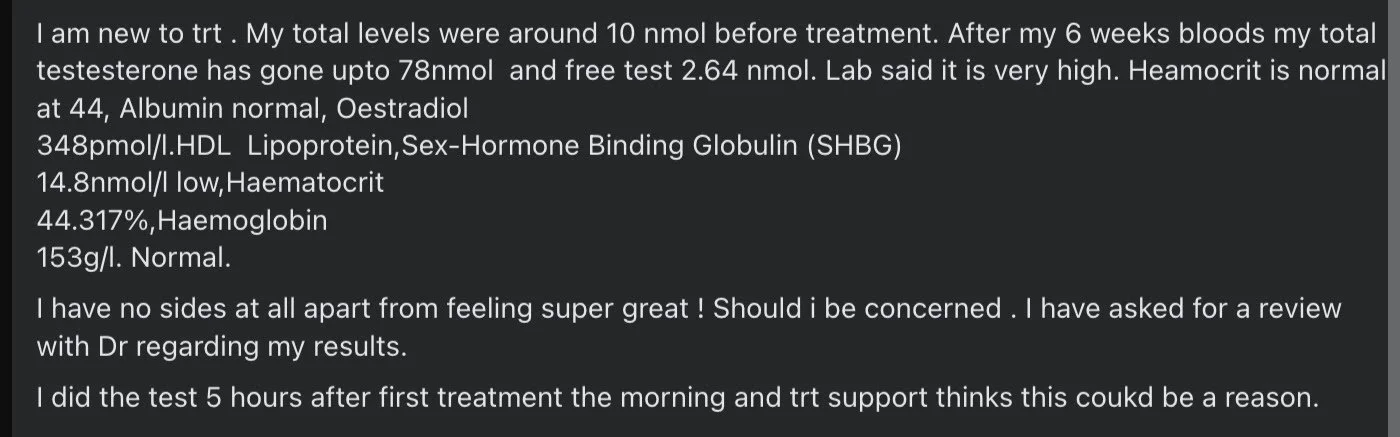
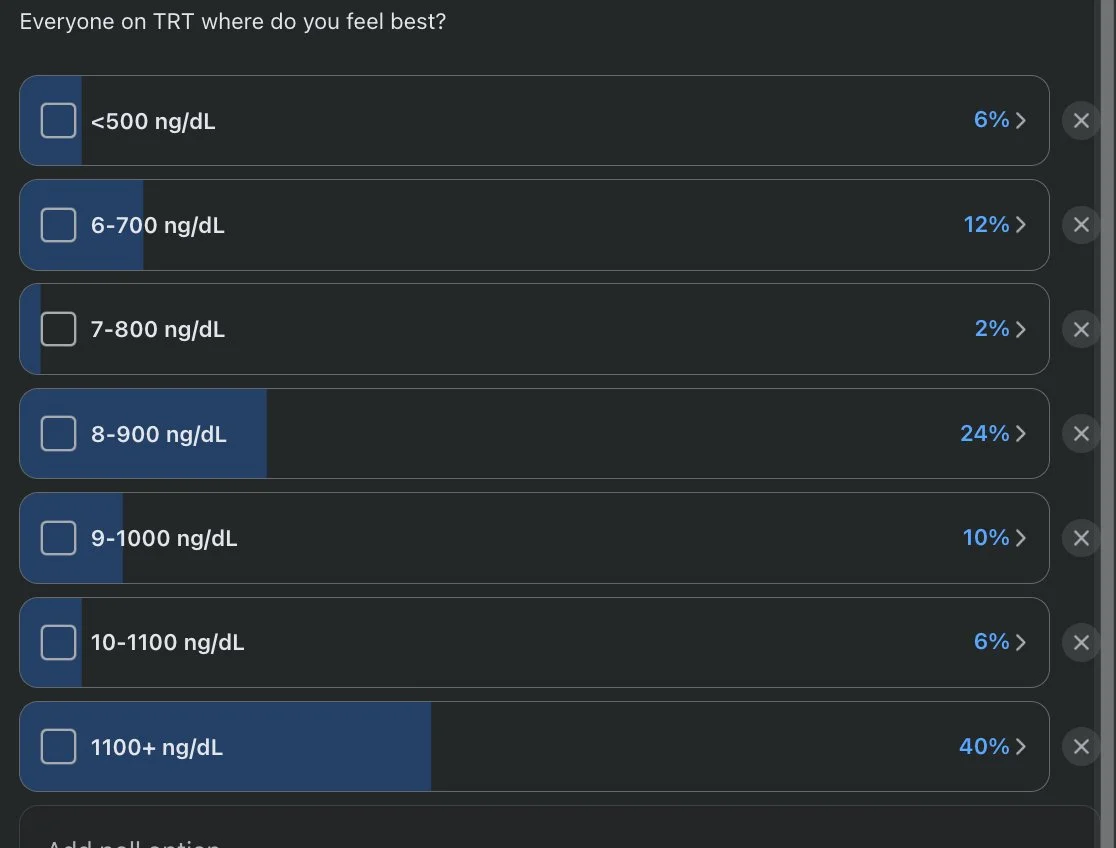
Put timing and preference together and a lot of men nominally "on TRT" are living in supratherapeutic territory — above the range, for most of the week, often without knowing it.
One last bit of scale. TRAVERSE — the biggest recent safety trial on TRT, and the one that got TRT's heart-risk warning removed — only took its men to a median of about 375 ng/dL (~13 nmol/L). [14] Low-normal. A lot of real-world users run two to three times that, well past where the safety science actually looked. (I pull that study apart in a separate article here.)
What The Documentation Says About These Higher Dosing Levels
Since we're in "supratherapeutic" territory, here's what the pharmaceutical companies themselves are required to disclose. [2]
On abuse:
"Drug abuse is intentional non-therapeutic use of a drug, even once, for its rewarding psychological and physiological effects… There have been reports of misuse by men taking higher doses of legally obtained testosterone than prescribed and continuing testosterone despite adverse events or against medical advice."
On what that abuse is associated with:
"Serious adverse reactions have been reported in individuals who abuse anabolic androgenic steroids and include cardiac arrest [heart stops beating], myocardial infarction [heart attack], hypertrophic cardiomyopathy [enlarged heart muscle], congestive heart failure [heart can't pump properly], cerebrovascular accident [stroke], hepatotoxicity [liver damage], and serious psychiatric manifestations, including major depression, mania, paranoia, psychosis [loss of contact with reality], delusions, hallucinations, hostility and aggression."
And the additional reactions reported in men:
"transient ischaemic attacks [mini-strokes], convulsions [seizures], hypomania [mild mania], irritability, dyslipidemias [abnormal cholesterol levels], testicular atrophy [testicles shrink], subfertility [reduced fertility], and infertility [inability to have children]."
That's not a critic's list. It's the manufacturer's own required disclosure of what happens at the doses a meaningful share of "TRT" users are actually running.
The Risk Assessment
Line it up:
- The guideline "success" range: ~450–600 ng/dL (AUA) / up to 865 ng/dL (BSSM)
- Where many users report feeling best: above 600, a large share above 800 (small, non-representative samples)
- Supratherapeutic: anything above that band
- What the documentation ties to supratherapeutic/abuse levels: physical dependence, plus the adverse reactions above
Dr Michael Israetel, PhD — exercise scientist, co-founder of Renaissance Periodization — put the dosing reality plainly: [6]
"Some doctors… will prescribe you a very top end to just above top end TRT, so instead of taking you from 150 ng/dL as [a low testosterone male] or from 400 ng/dL as a [normal testosterone] male to something like five or six hundred they will take you to 800 to 1200, possibly even you know 1100, or something over a thousand or close to it.
In that case, if you were below that range to begin with, which you probably were, you will very likely see increases in sexual function and desire… a higher degree of alertness as well as athletic performance, and much notably better body composition… However, your health markers are likely to decline marginally because you are now taking in lots and lots of testosterone and your tendency towards frustration, aggression, and anxiety can… go up, bad side effects.
Because drumroll, you are in a super physiological state… if your body was humming along just fine producing 400 and now you're at 1200. You just multiplied your test exposure by three. Some of those effects are going to be positive, some are almost certainly going to be negative.
That is not replacement, that is enhancement. Nominally you say you're on TRT but really you are on that good shit, that gear gear, that's not TRT anymore because you're not replacing 1200 you're replacing 400 with 1200.
Not TRT. By name yes, by effect absolutely not."
That distinction matters. The further above your own baseline you're pushed, the more this stops being replacement and starts being enhancement, with the dependence and the risk profile that come with it.
Why This Matters for Your Decision
This isn't about judging anyone's choices. It's about knowing what you're actually signing up for before the first injection — not finding out a decade in, when getting off is its own project.
The pharmaceutical companies and the medical authorities have already drawn the lines: a defined success range, a "supratherapeutic" zone above it, and dependence along with documented adverse reactions tied to that zone. Most men are never walked through any of it before the first injection.
Most executives wouldn't sign a contract without reading the terms. Why commit to a biological protocol without the same clarity?
Can TRT Create Identity Dependency?
Physical dependence is half of it. There's a second half — quieter, and in some ways stickier. Psychologists call it therapeutic dependence: psychological reliance on a treatment beyond medical necessity. Let's call it identity dependency.
Spend time in the communities and the same viewpoint keeps surfacing, worded a dozen different ways:


Notice the language: myth. isn't curable. lifelong. Repeated enough, it hardens into a worldview — that testosterone decline is permanent and recovery isn't possible.
I'm not saying that's a coordinated message. I'm pointing out that a lot of men seem to have absorbed the belief that low testosterone is permanent, that the decline can't be reversed.
The evidence doesn't support that as a blanket rule. Permanent, structural low testosterone — the kind that genuinely can't recover — is the rare version, not the common one. Most low testosterone has a cause that can be addressed, which is a whole article of its own (I break the patterns down separately).
But that belief does something specific — it creates a binary:
- If natural recovery is a "myth" → TRT is the only option
- If TRT is the only option → stopping equals giving up
- If stopping equals giving up → staying on becomes paramount
The loudest voices in these communities often genuinely need TRT — real, documented structural damage, for whom it is lifelong and the right call. The issue isn't them. It's that a rule built for the few who can't recover gets repeated until it sounds like a rule for everyone — including the majority who might never have needed it. No conspiracy required: just true-for-them advice, landing on the wrong men.
Researchers Call This "Testosterone Seeking Behaviour"
This isn't only a forum observation. In 2020, a review of worldwide testosterone prescribing found:
"over the past 20 years, there has been a worldwide surge of T prescribing… In the United States, testosterone prescribing has tripled from 2001 to 2011. Furthermore, many have been prescribed testosterone without any prior testing of serum T level, or even more worryingly with normal initial T level." [7]
The same researchers named the pattern directly — "testosterone seeking behaviour" by men "whose views have been influenced by unregulated 'men's health' websites and online chatrooms" — driven by "promotional and educational activity to portray testosterone as an 'elixir' of sexual and cardio-metabolic youth." [7]
That was 2020. It has only accelerated. In November 2025, endocrinologists across the UK went public about the scale of it. Professor Channa Jayasena, who chairs the Society for Endocrinology's Andrology Network, said the worrying part is clinics "starting testosterone for men with normal testosterone levels" — and described what happens next: exogenous testosterone "suppresses the testicular and hormonal signals from the brain," so clinics "give a concoction of other drugs to stop that happening, the same approach used by anabolic steroid users." [15]
Read that back. An NHS endocrinologist, describing men who didn't need treatment being started on it — and then medicated further to manage what the treatment shut down. That's not a fringe warning. It's the dependence mechanism, playing out at scale, described by the people seeing it walk through the door.
So the two dependencies pull the same direction. The body makes stopping physically hard. The culture makes starting feel like the only option — and stopping feel like defeat.
Neither one tells you whether you needed the treatment in the first place.
The Question That Comes First
None of this means TRT is wrong. For a man with genuine structural failure it may be exactly right — and that's between him and his doctor.
But dependence — physical and psychological — is the reason the starting decision deserves more scrutiny than it usually gets. This isn't a supplement you trial for a month and drop if it's not for you. Testosterone from outside switches your own production off — so getting back off it means waiting for a system you suppressed to come back online. Starting and stopping aren't symmetric. Before accepting that this is lifelong, it's worth finding out whether you're one of the few with a documented structural issue, or the majority whose own machinery may still work.
Which loops back to the only question that settles it: why is your testosterone low — and is that a reason to replace it for good, or a reason to find what's driving it down?
That "why" is the whole ballgame — and it's worth answering before the first injection, not a decade in.
Educational information, not medical advice. Bring it to your own doctor.
References
[1] Muir CA, Wittert GA, Handelsman DJ. Approach to the Patient: Low Testosterone Concentrations in Men With Obesity. J Clin Endocrinol Metab. 2025;110(9):e3125-e3130.
[2] Depo-Testosterone (testosterone cypionate), Drug Abuse and Dependence section. FDA prescribing information (DailyMed) / Pfizer.
[3] Harvard Health. Is testosterone therapy safe? Take a breath before you take the plunge. 10 January 2014.
[4] American Urological Association. Testosterone Deficiency Guideline.
[5] British Society for Sexual Medicine. Guidelines on Adult Testosterone Deficiency.
[6] Israetel M. Is TRT for You? (2023).
[7] Al-Sharefi A, Quinton R. Current National and International Guidelines for the Management of Male Hypogonadism. Endocrinol Metab. 2020;35(3):526-540.
[8] Testosterone is a Schedule III controlled substance (Anabolic Steroids Control Act 1990).
[9] FDA. Class-wide labeling changes for testosterone products — Abuse and Dependence section, October 2016.
[10] UK — Nebido / Sustanon SmPC (medicines.org.uk), §4.4: dependence and withdrawal on abuse.
[11] Canada — Health Canada product monographs (e.g. Taro-Testosterone): dependence/withdrawal.
[12] Australia — TGA Product Information: abuse, dependence and withdrawal.
[13] New Zealand — Medsafe Data Sheet, Depo-Testosterone (Pfizer NZ), §4.8 dependence + §5.1 suppression mechanism.
[14] Lincoff AM, Bhasin S, Flevaris P, et al. Cardiovascular Safety of Testosterone-Replacement Therapy (TRAVERSE). N Engl J Med. 2023;389(2):107-117.
[15] Marsh S. "Social media misinformation driving men to seek unneeded NHS testosterone therapy, doctors say." The Guardian, 8 Nov 2025.